Following the approval of the Unified VAT Agreement and its implementation in January 2018, the Kingdom of Saudi Arabia introduced Value Added Tax (VAT) as part of its economic diversification strategy.
The VAT rate was later revised to 15% on July 1, 2020. Businesses operating in Saudi Arabia must comply with VAT regulations issued by the Zakat, Tax and Customs Authority, with proper invoicing, reporting, and tax return filing.
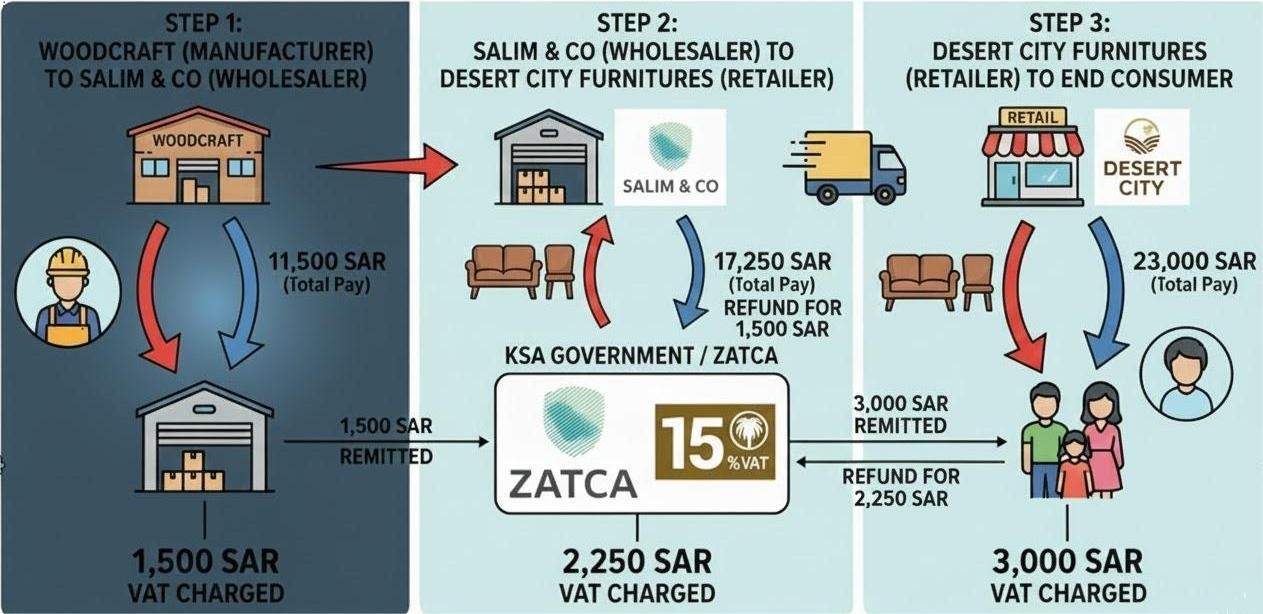
Value Added Tax is an indirect tax applied at each stage of the supply chain. Businesses collect VAT on sales and deduct VAT paid on purchases, remitting the net balance to ZATCA. The following example illustrates this flow across a typical supply chain.
Woodcraft, a furniture manufacturer, sells furniture to wholesaler Salim & Co for SAR 10,000 and charges 15% VAT (SAR 1,500), making the total invoice SAR 11,500
Salim & Co sells the furniture to retailer Desert City Furnitures for SAR 15,000 and charges 15% VAT (SAR 2,250), while claiming input VAT credit of SAR 1,500 paid to the manufacturer
Desert City Furnitures sells the product to the final consumer for SAR 20,000 and charges 15% VAT (SAR 3,000), while claiming input VAT credit from the previous purchase
The end customer pays a total of SAR 23,000 including VAT, while businesses in the supply chain remit the net VAT collected to ZATCA
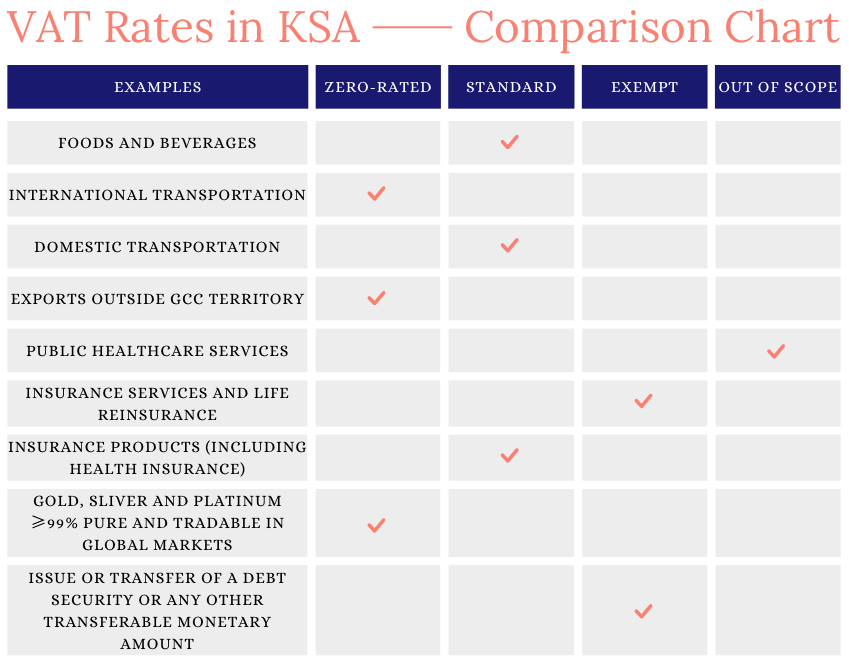
Most goods and services supplied within Saudi Arabia are subject to the standard VAT rate of 15% unless specifically classified as zero-rated or exempt.
Certain supplies are taxed at 0% VAT while businesses can still recover input VAT on related purchases.
Some goods and services are exempt from VAT, meaning no VAT is charged and businesses generally cannot claim input VAT on related expenses.
Taxable supplies refer to goods and services on which VAT is applied according to ZATCA regulations. These supplies may be taxed at either the standard rate or the zero rate depending on the nature of the transaction.
Standard-rated supplies are goods and services that are subject to the standard VAT rate of 15% in Saudi Arabia.
Zero-rated supplies are taxable goods and services that are charged VAT at 0%. Although VAT is not collected on sales, businesses can still claim input VAT on related purchases and expenses.
Exempt supplies are goods or services that are not subject to VAT. Businesses dealing only in exempt supplies cannot charge VAT on their sales and are generally not eligible to claim input VAT on purchases.
Out-of-scope supplies refer to transactions that fall outside the VAT system and therefore are not subject to VAT. These usually occur when a supply is made outside Saudi Arabia or when the transaction is not considered an economic activity.
Goods imported into Saudi Arabia are generally subject to VAT at the applicable rate unless specifically exempt. Import VAT is usually collected by Saudi Customs.
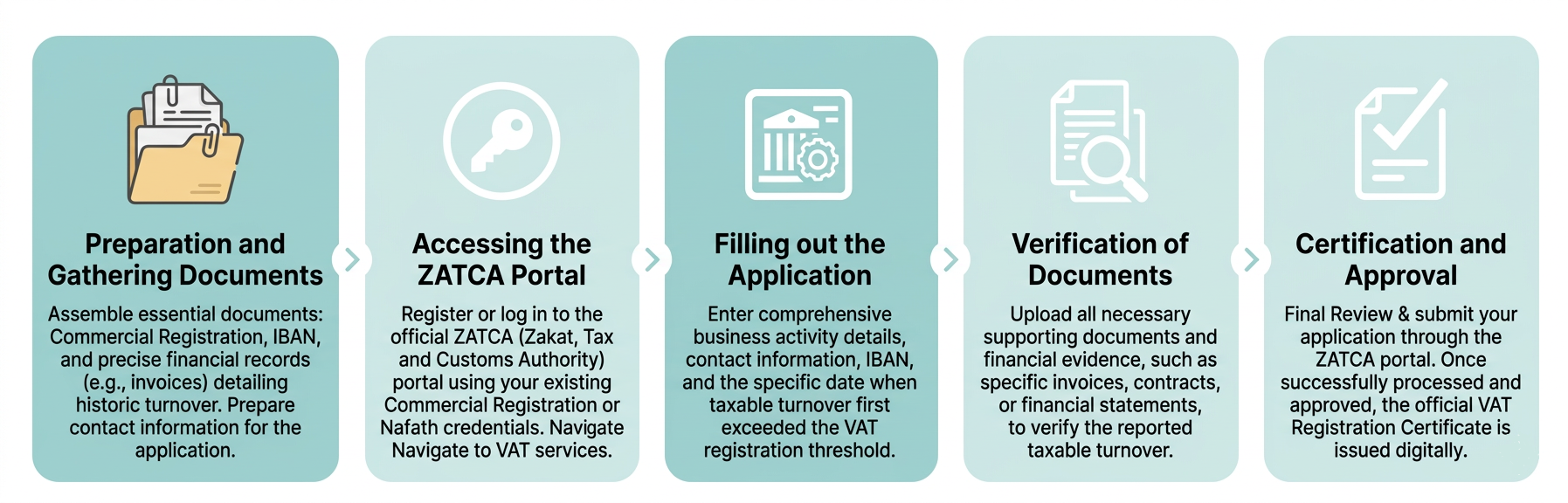
Businesses making taxable supplies in Saudi Arabia must assess whether they meet ZATCA VAT registration threshold. Registered businesses can legally charge VAT and report it to the tax authority.
Businesses whose annual taxable supplies exceed SAR 375,000 must register for VAT with ZATCA. The threshold is determined based on taxable supplies made during the previous 12 months or expected in the upcoming 12 months.
Businesses with annual taxable supplies above SAR 187,500 but below SAR 375,000 may choose voluntary VAT registration, allowing them to recover input VAT on purchases and operating expenses.
Non-resident businesses supplying goods or services in Saudi Arabia must register for VAT regardless of turnover and appoint a local tax representative responsible for VAT compliance and reporting.
Two or more legal entities under common control in Saudi Arabia may register as a VAT group. To be eligible, all members must be legal residents of Saudi Arabia, actively conduct economic activity, and meet specific statutory criteria set by ZATCA.
ZATCA provides a taxpayer lookup service that allows businesses to verify the VAT registration status of any entity using its VAT number, Commercial Registration number, or VAT certificate details.
Businesses may apply for VAT deregistration if they cease taxable activities or if their taxable turnover falls below the voluntary registration threshold through the ZATCA online portal.
A VAT return is a report submitted by businesses to ZATCA showing the VAT collected on sales (output VAT) and the VAT paid on purchases (input VAT) during a specific tax period. The return is filed electronically through the ZATCA portal and helps determine the amount payable or refundable for that period.
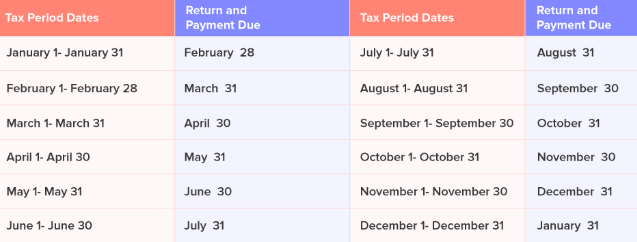
Businesses with an annual taxable turnover of SAR 40 million or less typically file VAT returns quarterly. These periods cover January-March, April-June, July-September, and October-December. Both the return and payment must be submitted by the last day of the month following the end of the quarter.
Businesses with an annual taxable turnover exceeding SAR 40 million are required to submit VAT returns monthly. Each return reports the VAT activity for a single calendar month and must be submitted, along with payment, by the last day of the following month.
VAT payments are made to ZATCA via SADAD payment system using an invoice number generated after submitting the VAT return. Payments can be made through online banking, ATMs, or the ZATCA portal using Mada or credit cards. To avoid late payment penalties, ensure payment is completed by the last day of the month following the tax period.
Any error is discovered after submission, it must be corrected. Minor errors resulting in a tax difference of less than SAR 5,000 can be adjusted in the next VAT return. Larger differences of SAR 5,000 or more must be reported immediately by submitting a VAT Return Amendment through the ZATCA portal.
ZATCA imposes penalties for non-compliance with VAT regulations, including late registration, incorrect filing, and failure to maintain proper tax records.
ZATCA has extended the Penalty Waiver Initiative until June 30, 2026. Penalties for late registration, filing, and payments may be waived for eligible taxpayers who settle their principal tax debt before the deadline. This waiver does not apply to tax evasion.
E-Invoicing (Fatoorah) is the mandatory process of issuing, exchanging, and storing tax invoices and related notes in a structured digital format through an integrated electronic system. In Saudi Arabia, the Zakat, Tax and Customs Authority (ZATCA) requires VAT-registered businesses to generate invoices, credit notes, and debit notes electronically to ensure standardized, secure, and transparent transaction records. This system helps ensure that transactions, including domestic sales and exports, follow a consistent digital format and cannot be altered once issued.
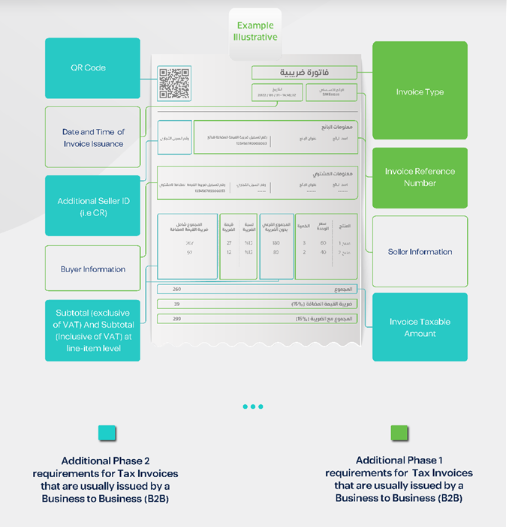
The standard document issued between businesses. It must contain all mandatory ZATCA tax elements and be integrated with ZATCA systems for Phase 2 compliance.
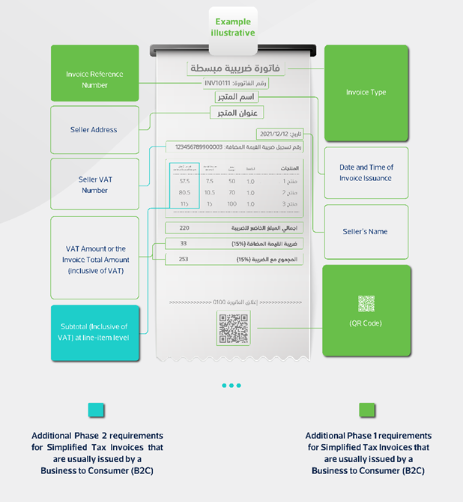
The digital document issued by a business to a consumer. These invoices usually include a QR code that allows instant verification of the transaction details.
Issued to reduce the value of a previously issued invoice. It is commonly used for product returns, correcting overstated amounts, or adjusting excess VAT collected.
Issued to increase the value of a previously issued invoice. This may occur when a customer was undercharged, additional goods were delivered, or insufficient VAT was applied.
Effective December 4, 2021, all VAT-registered businesses must generate and store tax invoices and electronic notes through a ZATCA-compliant e-invoicing system.
Invoices must be issued using electronic systems such as cloud platforms, POS systems, or installed invoicing software. Manual handwritten invoices are not permitted.
Mandatory invoice fields must be included such as VAT number, timestamp, VAT amount, and total transaction value.
Simplified invoices for B2C transactions must include a QR code to allow quick verification by customers.
Invoices are generated and stored electronically but do not need to be reported to ZATCA during this phase.
Effective January 1, 2023, businesses must integrate their invoicing systems with the ZATCA Fatoora platform to enable invoice validation and reporting.
E-invoices must follow approved formats such as XML or PDF/A-3 with embedded XML to ensure compliance and validation.
Systems must support secure API integration with ZATCA to allow invoice clearance and reporting.
Each invoice must include UUID, digital signatures, cryptographic stamps, and invoice hashing for security.
ZATCA implements this phase in waves and businesses are notified at least six months before integration.

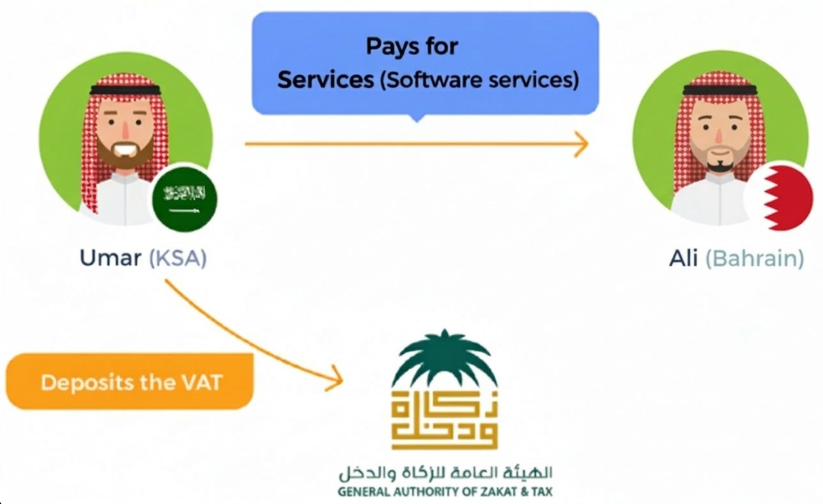
The Reverse Charge Mechanism (RCM) is a VAT rule where the responsibility for reporting and paying VAT shifts from the supplier to the buyer. Instead of the supplier charging VAT on the invoice, the buyer records both Output VAT and Input VAT in their VAT return for the same transaction.This mechanism ensures that VAT is properly accounted for even when the supplier is not registered for VAT in Saudi Arabia.
When a VAT-registered business in Saudi Arabia receives taxable services from a non-resident supplier located outside the Kingdom.
When services are provided by suppliers who are not registered for VAT in KSA but deliver services to businesses within the Kingdom.
Certain cross-border transactions between GCC member states where the supplier does not charge VAT in the destination country.
A VAT-registered electronics retailer in Saudi Arabia subscribes to a software service provided by a UK-based company.
Since the supplier is not registered for VAT in Saudi Arabia, VAT is not charged on the invoice.
Because the service is delivered electronically, it does not pass through Customs.
The Saudi business must calculate and report VAT on the transaction using the reverse charge mechanism in its VAT return.
Place of Supply refers to the geographic location where a transaction is considered to occur for VAT purposes. Determining the place of supply helps businesses identify which country has the right to apply VAT and whether the transaction is domestic, export, or out-of-scope under Saudi VAT regulations.
For domestic transactions within Saudi Arabia, the place of supply is Saudi Arabia and VAT applies according to the applicable rate.
When goods are transported between GCC member states, the place of supply is generally the destination country where the goods are delivered.
When goods are exported outside the GCC, the place of supply remains Saudi Arabia but the transaction may qualify for zero-rated VAT treatment.
When goods are imported into Saudi Arabia, VAT is usually collected at Customs and the place of supply is considered Saudi Arabia.
For services, the default rule is that the place of supply is the location where the supplier resides or operates. However, certain services may follow specific rules depending on where the service is performed or consumed.
Business-to-Business (B2B) Services Place of supply is the location of the customer.
Real Estate Services Place of supply is where the property is located.
Transportation Services Place of supply is where the transportation takes place.
Events, Cultural, or Educational Services Place of supply is where the event or service is performed.
Telecommunication and Electronic Services Place of supply is where the service is used.
Services provided by a non-resident supplier may have the place of supply determined based on where it is consumed.
Under the KSA VAT system, businesses must account for both input VAT paid on purchases and output VAT collected on sales. Properly managing these amounts ensures accurate VAT reporting and determines whether a business must pay VAT to ZATCA or claim a refund.
Input VAT is the tax paid by a business on purchases of goods or services, while Output VAT is the tax collected on sales made to customers. The difference between the two determines the amount payable to ZATCA or refundable to the business.
Businesses registered for VAT may deduct input VAT paid on purchases that are directly related to their taxable business activities, including goods or services used to produce standard-rated or zero-rated supplies.
Input VAT paid on capital assets used for business purposes may also be deducted. The eligibility depends on the nature of the asset and payment terms such as full payment or installment arrangements.
Input VAT cannot be claimed for goods or services used for personal purposes or non-business activities. Certain expenses such as entertainment services or restricted motor vehicles may also be excluded.
If the total input VAT exceeds output VAT during a tax period, the business may be eligible for a refund. The refundable amount may be claimed from ZATCA or carried forward to offset future VAT liabilities.
Businesses must claim their input VAT within the allowed timeframe. Under ZATCA regulations, deductions can typically be claimed within five years from the date the tax was originally incurred.
Businesses must retain VAT-related records for the required period to ensure compliance and support audits by ZATCA.
Standard business VAT records must be properly maintained and kept for at least 6 years
Records related to immovable assets such as real estate must be retained for up to 15 years.
VAT records must generally be maintained within Saudi Arabia and must remain accessible to ZATCA when requested.
Records may be stored physically or electronically in a secure format.
Records must remain readable, tamper-resistant, and available for audit purposes.
Businesses must maintain proper documentation supporting VAT returns and financial records.
Tax invoices, simplified invoices, credit notes, debit notes, and other financial documents.
VAT calculations, VAT returns, and accounting records such as transaction logs.
A VAT account records the balance of tax payable or refundable between a business and ZATCA.
Tracks VAT collected on sales (Output VAT) durin business transactions.
Tracks VAT paid on purchases (Input VAT) and adjustments during filings.